
What Are Compute-Based Usage Caps? Decoding Google Gemini's Usage Limits
In 2026, Google Gemini stopped capping usage by a simple count of messages and started capping it by how much computing work each request actually takes — here's what changed and why some subscribers hit the wall faster than they expected.
A compute-based usage cap doesn't count how many times you use an AI tool — it measures how much computing work each use actually takes, so a short question and a long video-generation request drain the same limit at very different rates. Google Gemini switched to this model in 2026, replacing simple prompt counts with a rolling quota that refreshes every five hours and builds toward a weekly ceiling, with higher subscription tiers granting a larger multiple of that quota rather than a fixed daily number. Because cost depends on the model, feature, and length of a request rather than a simple tally, the same subscription can feel generous on one day and exhausted within minutes on another.
Where this actually shows up
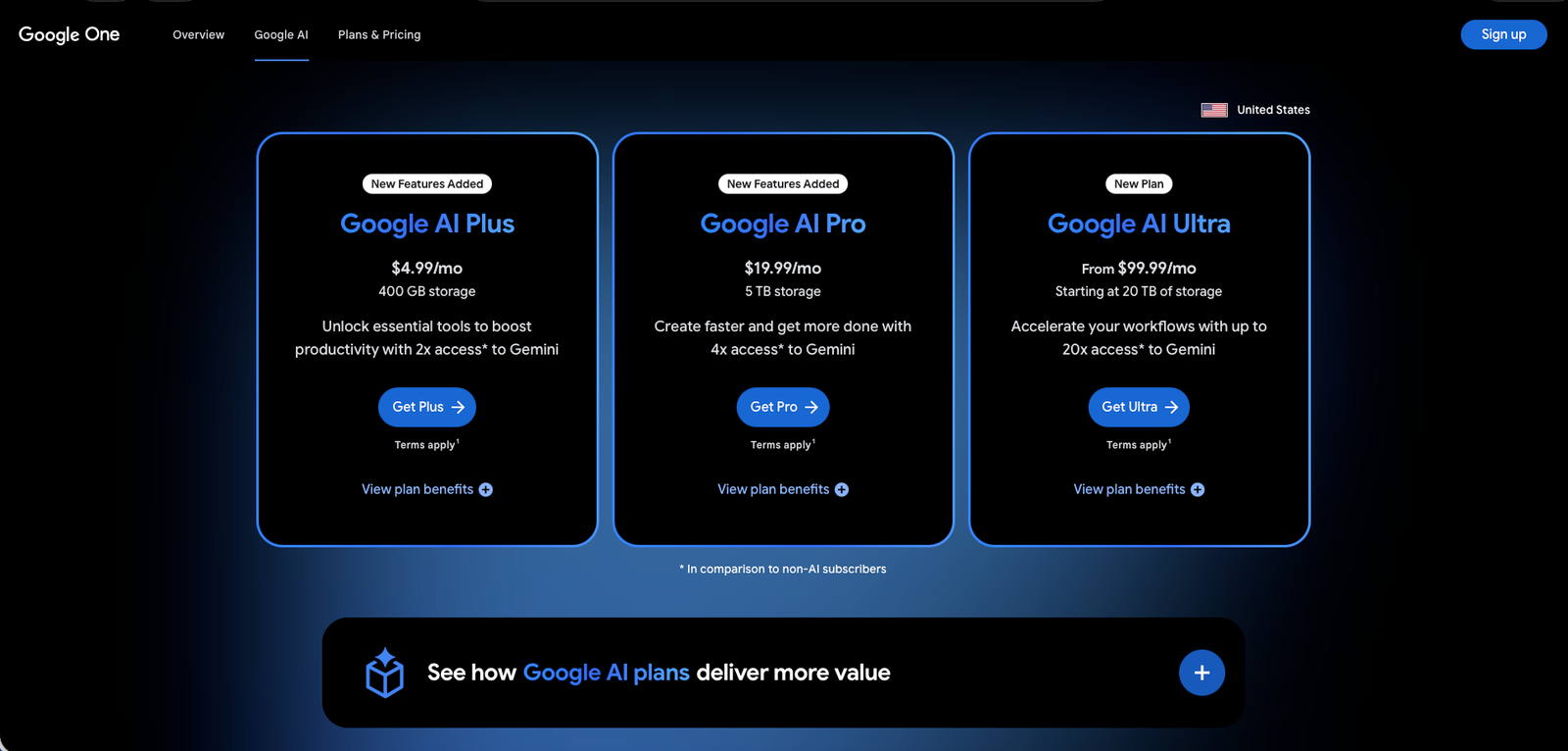
Google's official Google AI plans page, showing the Plus, Pro, and Ultra tiers alongside their relative access multiples to Gemini. Captured Jul 21, 2026.
How it actually works
Before 2026, Google described Gemini's tier differences in vague terms — "more" or "higher" usage for paid plans — without publishing concrete figures. Starting around Google I/O 2026 and rolling out more broadly by May 21, 2026, Google switched to compute-based usage limits: a rolling quota that refreshes every five hours, with those refreshes counting toward a separate weekly cap. Once the weekly cap is reached, access pauses until the next weekly cycle even if a five-hour block would otherwise refresh.
What makes this different from a simple message count is that each action draws down the quota by a different amount depending on which model answers it, how long and complex the prompt and conversation are, and which feature is used. Google's own help documentation states that "more advanced models and higher thinking levels consume more of your usage," and that heavier features — Deep Research, image and video generation, and extended "thinking" modes — draw more from the same quota than an ordinary chat message.
Paid tiers grant a multiple of that quota rather than a fixed number of uses, measured against a non-subscribing user's standard limit:
| Plan | Monthly price | Access to Gemini |
|---|---|---|
| Free | $0 | Standard baseline |
| Google AI Plus | $4.99 | 2x standard limit |
| Google AI Pro | $19.99 | 4x standard limit |
| Google AI Ultra | $249.99 ($124.99 for the first 3 months) | Up to 20x standard limit |
Google does not publish exact prompt or token counts behind these multipliers — only the relative comparisons above — and its own documentation adds that "Gemini Apps limits may change without notice, including due to capacity constraints." The May 2026 rollout drew visible pushback, partly because Google's published multipliers compare each paid tier to the free plan rather than to that same tier's own limit before the change, and partly because heavier models and features could exhaust a five-hour block unusually fast. In response, on May 28, 2026, Google capped how much quota a single prompt can consume, made its lightweight Flash-Lite model free of quota charge, fixed a bug that was draining quota disproportionately on video generation (doubling Google AI Ultra's video-generation allowance as part of the fix), stopped counting failed requests against the quota, and said it plans to let subscribers buy additional usage beyond their limit.
Why it matters when you're buying
Because the cap isn't a fixed number, the practical value of a Gemini subscription depends heavily on how it gets used. Two Google AI Pro subscribers paying the same $19.99 a month can have very different experiences: one mostly sending short text questions, another regularly using compute-heavy features like video generation, Deep Research, or extended "thinking" modes that draw down the same quota far faster.
That gap showed up in real complaints after the May 2026 change — one documented case involved a Google AI Pro subscriber whose avatar-style video generation consumed an entire five-hour quota block within minutes, with the video failing anyway and no refund of that usage under the rules at the time. For anyone evaluating a Gemini plan, the useful question is no longer just "how many messages do I get," but which specific features are actually part of the plan, since a 2x or 4x headline multiple can translate into very different real-world usage depending on the mix of features involved.
Where else you'll see this
Usage limits that scale with the computing cost of a request, rather than a flat per-message count, have also appeared in other AI subscriptions — including ChatGPT's rolling message windows and GitHub Copilot's per-token AI Credits system — each with its own reset schedule and rules for what counts against the limit.
Frequently asked questions
What is a compute-based usage cap?
It's a usage limit that measures how much computing work a request actually takes — factoring in the model used, the feature involved (chat versus image or video generation versus research), and the length of the conversation — rather than simply counting how many messages were sent.
How often does Gemini's usage limit reset?
The quota refreshes every five hours, and those refreshes count toward a separate weekly cap. Once the weekly cap is reached, access pauses until the next weekly cycle even if a five-hour block would otherwise refresh.
How much more access do paid Gemini plans get?
Compared to a non-subscribing user's standard limit, Google AI Plus ($4.99/month) gets 2x access, Google AI Pro ($19.99/month) gets 4x, and Google AI Ultra ($249.99/month, with a $124.99 introductory rate for the first three months) gets up to 20x.
Why can one video or research request use up an entire quota block?
Because consumption scales with computing cost, not with a flat per-message count. More advanced models, longer conversations, and heavier features like video generation, Deep Research, or extended thinking modes draw down the quota much faster than a short chat message.
What did Google change after the May 2026 backlash?
Google capped how much quota a single prompt can consume, made its lightweight Flash-Lite model free against the quota, fixed a bug that was draining quota disproportionately on video generation, stopped counting failed requests against the limit, and said it plans to let subscribers buy additional usage beyond their quota.
This explainer is part of Alivoi's AI Explained series, where we break down one AI pricing or product mechanic at a time.
Sources
- Google — Google AI plans, one.google.com/about/google-ai-plans (accessed Jul 21, 2026)
- Google — "Gemini Apps limits & upgrades for Google AI subscribers," Gemini Apps Help, support.google.com/gemini (accessed Jul 21, 2026)
- Google — "Understanding Gemini Apps usage limits," Gemini Apps Community Guide, support.google.com/gemini (accessed Jul 21, 2026)