
What Are AI Agent Permissions? Understanding Meta Muse's Approval Controls
An agent that can act for you raises a practical question: which decisions have you actually handed over?
The short version
AI agent permissions define what an assistant is allowed to access or do on your behalf. An approval gate is a pause that requires your decision before a particular action can proceed. The useful question is not simply whether an agent asks permission, but what each approval covers and when it ends.
Where this actually shows up
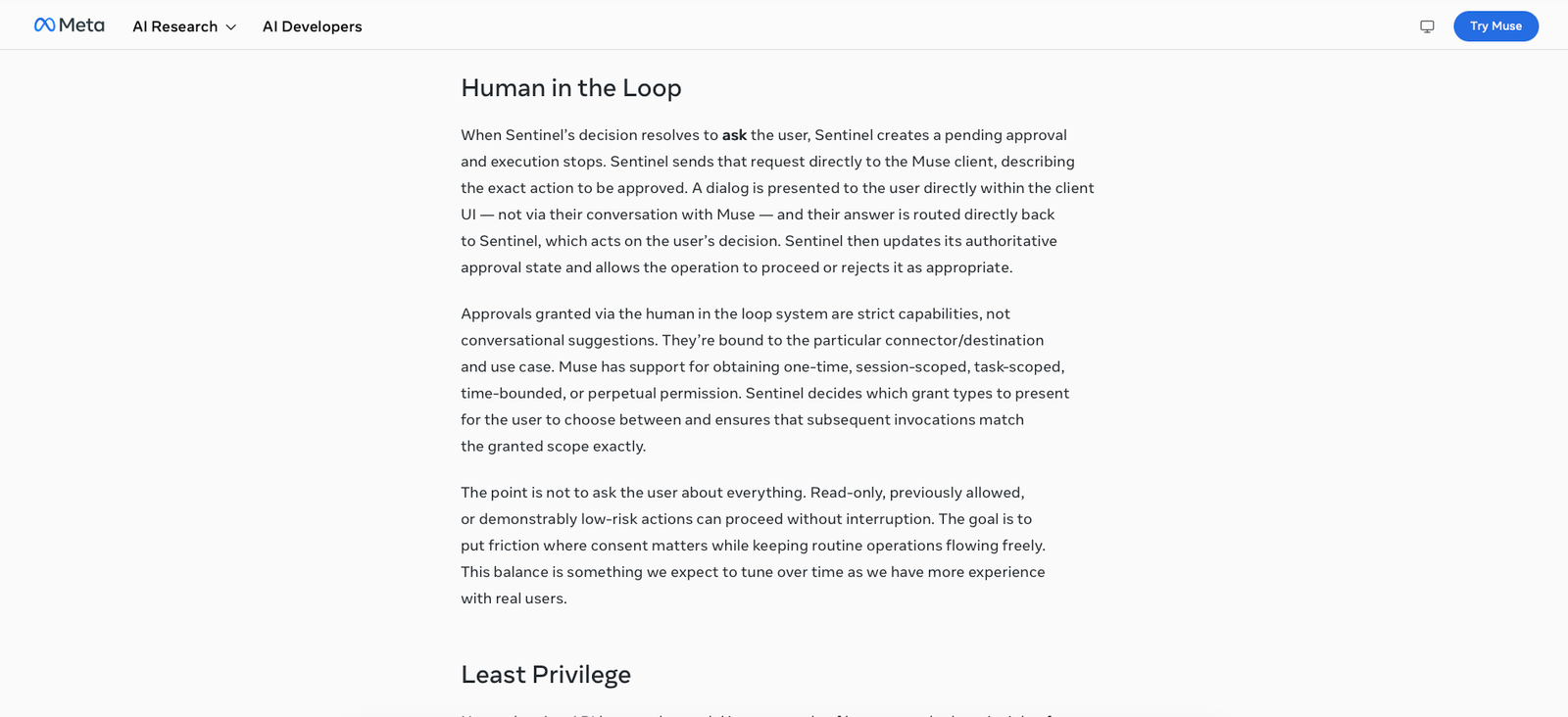
Meta Muse illustrates this distinction. Meta describes a separate permission system called Sentinel that checks proposed actions and can allow, reject, or request approval for them.
How it actually works
According to Meta, a request needing approval pauses execution and appears in a dedicated interface dialog. Muse supports five grant scopes: one action, a session, a task, a limited period, or ongoing permission. Sentinel determines which options appear. Some previously authorized or low-risk actions can proceed without another interruption.
To interpret a permission request, separate three questions: what action is allowed, what it applies to, and how long the permission lasts. Consider this hypothetical calendar task:
| Question | Narrow example | Broader example |
|---|---|---|
| What action? | Read availability | Create or change events |
| Which data? | One work calendar | All connected calendars |
| For how long? | Arrange this meeting | Continue managing future meetings |
These are illustrative permission boundaries, not a reproduction of Muse's settings. “Find a time for lunch” expresses a goal; the approval screen should make the actual delegation understandable. A useful review question is whether the proposed access is necessary for that goal.
Meta also says Muse separates reading from changing data where the connected service supports it, and requests approval for purchases. These are documented controls, not an independent guarantee of error-free operation.
Why it matters when you're buying
Imagine evaluating an assistant for a small team. Your trial task is to prepare a client meeting. Before subscribing, decide what success includes: collecting availability, proposing a time, creating the event, or sending invitations. Those are different levels of delegation even when they belong to the same workflow.
Use that task to assess the product's controls. Can you understand what will happen before approving it? Is the affected account clear? Can you identify when the permission ends? Does the product explain how to review or withdraw ongoing access? These questions make a practical acceptance checklist; they do not assume every product offers the same settings.
There is also a workflow trade-off. Approving every small step may interrupt the work you wanted to delegate. A broad grant may leave you reviewing less than you intended. Choose the boundary you would be comfortable explaining to the person whose calendar, inbox, or budget is affected.
Frequently asked questions
What should I look for in an approval request?
Check the proposed action, the affected account or data, and the duration of access. If you cannot explain what you are approving in one sentence, clarify the request first.
Should I approve ongoing access for a one-off task?
Consider whether future access serves any purpose beyond the current task. A one-off request is a useful reason to look for a narrower permission option.
Is approving an action the same as checking its accuracy?
No. Treat authorization and accuracy as separate checks. For a hypothetical meeting invitation, review the recipient, date, and message as well as whether the assistant may send it.
Explore more concepts in Alivoi's AI Explained series.
Sources
- Meta AI Research — How We Built Safety Into Muse, especially “A Built-In Sentinel,” “Human in the Loop,” “Least Privilege,” and “Purchases.” (accessed Sep 10, 2026)