
What Are AI Credits? Decoding GitHub Copilot's Usage-Based Pricing
On June 1, 2026, GitHub Copilot stopped counting a flat number of monthly requests and started spending a prepaid credit balance instead — here's what that actually changes for anyone paying for it.
AI credits are a prepaid balance built into a subscription: instead of a fixed monthly allowance of requests, each AI action is priced by how much computing work it actually takes and deducted from that balance until it reaches zero. GitHub Copilot moved its Pro, Pro+, and Max plans to this model on June 1, 2026, converting each plan's price into an equivalent monthly credit balance that different AI models draw down at different rates. Once the balance is spent, extra usage either pulls from an optional paid top-up or pauses until the next billing cycle.
Where this actually shows up
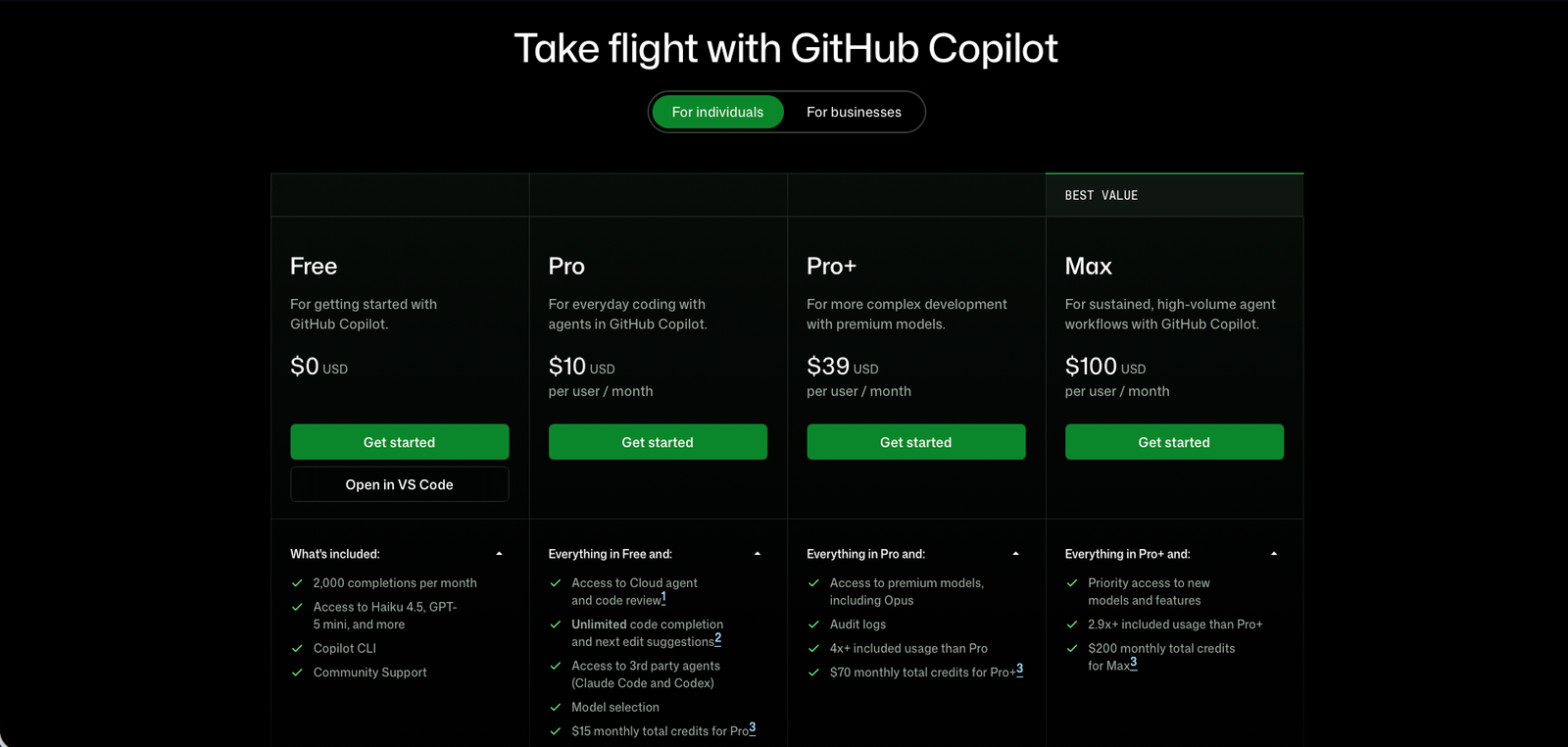
GitHub Copilot's plans and pricing page, showing the monthly AI Credits balance listed under each plan. Captured Jul 20, 2026.
How it actually works
Until June 1, 2026, Copilot's paid plans worked on a flat monthly quota of "premium requests" — 300 for Pro, 1,500 for Pro+ — where a chat message counted as 1 request but a code review counted as 13, and extra requests beyond the quota were billed at a flat $0.04 each. The new system replaces that per-request quota with a dollar-denominated AI Credits balance, where 1 AI credit equals $0.01. Code completions and Next Edit Suggestions stay unlimited and never touch the balance; everything else — chat, CLI commands, code review, and agent sessions — draws from it.
Each plan's monthly credit balance is split into a "base" amount and a "flex" allotment for variable extra usage:
| Plan | Monthly price | Monthly AI Credits |
|---|---|---|
| Free | $0 | 2,000 completions + limited chat/agent |
| Pro | $10 | $15 ($10 base + $5 flex) |
| Pro+ | $39 | $70 ($39 base + $31 flex) |
| Max | $100 | $200 ($100 base + $100 flex) |
Credits aren't spent per prompt — they're spent per token. Every chat message, CLI command, code review, or agent step is priced using the input tokens sent to the AI model, the output tokens it generates, and any cached tokens reused from earlier in the conversation, each billed at that specific model's published rate and converted to credits. An agent session is metered per session plus per steering comment rather than per back-and-forth message, so a longer autonomous run accumulates cost with every step it takes. The rate itself depends heavily on which model handles the request:
| Model tier | Example model | Input / 1M tokens | Output / 1M tokens |
|---|---|---|---|
| Lightweight | GPT-5 mini | $0.25 | $2.00 |
| Versatile | Claude Sonnet 4.5 | $3.00 | $15.00 |
| Powerful | Claude Opus 4.8 | $5.00 | $25.00 |
On individual plans, once the monthly balance hits zero, a user can set a dollar budget for additional usage and Copilot keeps working, billing further usage at the same per-credit rate. On Business and Enterprise plans, an administrator decides whether paid overage is allowed at all — if it isn't, Copilot pauses for that user until the next cycle. Balances reset to the plan's full amount on the 1st of each month at 00:00 UTC, and unused credits do not carry over.
Why it matters when you're buying
A credit-based plan means the advertised price no longer describes a fixed amount of access — it describes a spendable balance, and how far that balance goes depends entirely on usage pattern. Two people on the same $10/month Copilot Pro plan can have very different months: one doing quick autocomplete-style chat with a lightweight model, another running long autonomous agent sessions on a higher-tier model that reads large amounts of code and generates long responses.
That gap is not hypothetical. On GitHub's own community forum, developers reported exhausting an entire Pro+ balance within one or two days of ordinary use after the switch, and one developer estimated that a single extended agentic coding session can run $30 to $40 in credits — more than double a Pro+ plan's full monthly balance, and several times a Pro plan's. For anyone evaluating a coding assistant, the practical questions are no longer just "what's the monthly price" but also: does this plan's balance cover the way I actually intend to use it, is overage automatic or does it require opting in, and does going over pause access or simply keep billing.
Where else you'll see this
Prepaid or metered AI-credit systems along similar lines have also appeared in other coding and app-building tools, including Cursor, Replit, Windsurf, and Lovable — each with its own balance sizes, included allowances, and rules for what happens after the balance runs out.
Frequently asked questions
What counts as one GitHub Copilot AI credit?
One AI credit equals $0.01 of underlying token cost. Every chat message, CLI command, code review, or agent action is priced in tokens at the rate of whichever AI model handles it, then converted into credits at that fixed $0.01 rate.
How many AI credits come with each Copilot plan?
Free includes 2,000 code completions per month plus limited chat and agent access. Pro ($10/month) includes $15 in monthly credits. Pro+ ($39/month) includes $70. Max ($100/month) includes $200.
Do code completions use up AI credits?
No. Inline code completions and Next Edit Suggestions remain unlimited and don't draw from the credit balance. Only chat, CLI, code review, and agent interactions do.
What happens when Copilot credits run out mid-month?
On individual plans, a user can opt into a dollar budget for extra usage, billed at the same per-credit rate, or wait for the balance to reset on the 1st of the next month. On Business and Enterprise plans, an administrator controls whether paid overage is allowed at all.
Why do some coding sessions burn through credits faster than others?
Cost scales with which AI model is used and how many tokens it processes. A short chat exchange with a lightweight model spends far fewer credits than an extended autonomous agent session on a higher-tier model across many steps, since each step's input and output tokens are billed separately.
This explainer is part of Alivoi's AI Explained series, where we break down one AI pricing or product mechanic at a time.
Sources
- GitHub Copilot — Plans & pricing, github.com/features/copilot/plans (accessed Jul 20, 2026)
- The GitHub Blog — "GitHub Copilot is moving to usage-based billing," github.blog (accessed Jul 20, 2026)
- GitHub Docs — "Models and pricing for GitHub Copilot," docs.github.com (accessed Jul 20, 2026)
- GitHub Docs — "Requests in GitHub Copilot" (legacy premium-request system), docs.github.com (accessed Jul 20, 2026)